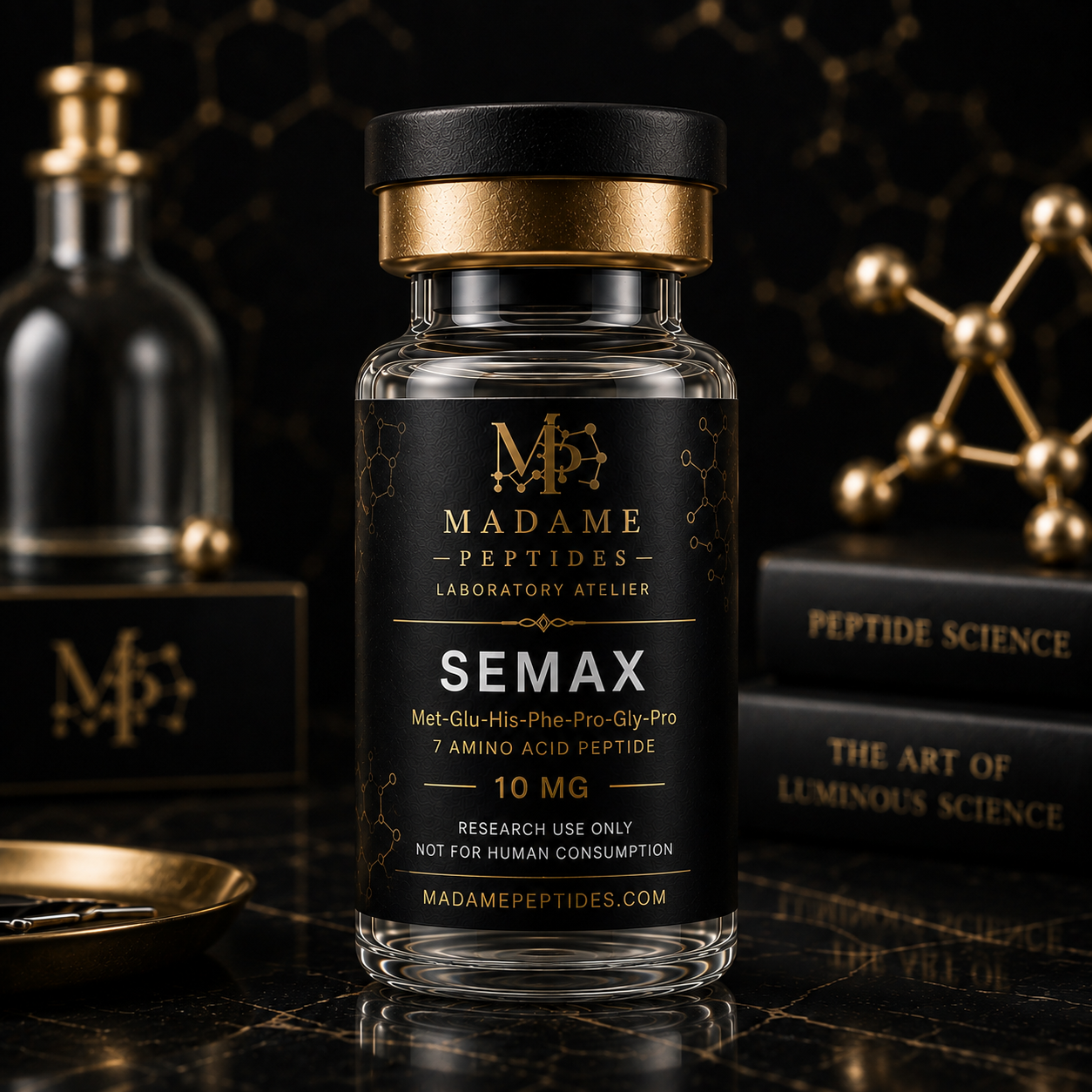

SEMAX
Semax is a synthetic heptapeptide composed of seven amino acids (Met-Glu-His-Phe-Pro-Gly-Pro). It was developed from a fragment of adrenocorticotropic hormone (ACTH), but unlike ACTH itself, Semax was designed without the hormonal activity normally associated with the parent molecule. It has attracted research interest primarily within the fields of neuroscience, cognitive function, neuroprotection, and cellular responses to neurological stress.
One of the major areas of Semax research involves neurotrophic signaling. Preclinical studies have investigated its relationship with signaling molecules such as brain-derived neurotrophic factor (BDNF) and nerve growth factor (NGF), which participate in neuronal survival, plasticity, learning, memory, and the nervous system's response to injury.
Semax has also been investigated in experimental models involving learning, memory formation, attention, oxidative stress, inflammation, and cerebral ischemia. Researchers have examined changes in gene expression and molecular signaling following Semax exposure, particularly within brain regions associated with cognition and neurological recovery.
Another interesting area of investigation involves the relationship between Semax and stress-related neurological and behavioral processes. Experimental studies suggest that its biological activity may involve several interacting neurotransmitter and neurotrophic pathways rather than one isolated mechanism.
Although Semax is sometimes grouped with sleep or circadian research compounds, it is more accurately characterized as a neuroregulatory and cognitive research peptide. Some preclinical research has explored its relationship with circadian activity, but current evidence does not establish Semax as a sleep treatment or sleep-inducing peptide.
Semax has been investigated in human research, including neurological settings, but the overall evidence base remains limited compared with established pharmaceutical therapies, and a substantial portion of the mechanistic literature comes from animal and laboratory studies.
For laboratory research purposes only. Not for human consumption.
Semax, BDNF & TrkB, 2006: Animal research examining Semax and the BDNF/TrkB neurotrophic system in the hippocampus, including changes in BDNF protein and gene expression.
Semax, BDNF & NGF Gene Expression, 2008: Investigated changes in BDNF and nerve growth factor (NGF) gene expression in the rat hippocampus and frontal cortex.
Semax & Experimental Cerebral Ischemia, 2006: Preclinical research examining neuroprotective and memory-related effects of Semax following experimentally induced cerebral ischemia.
Semax & Circadian Rhythm, 2008: Particularly useful for why we've included Semax around the Sleep & Circadian category. This rat study investigated Semax's effects on circadian locomotor rhythms. It does not establish Semax as a sleep aid.
